You know what kills most US businesses trying to scale customer support?
It’s not the lack of talent. It’s not even the budget.
It’s the clock.
Your customers need help at 9 AM Eastern. Your support team in the Philippines is asleep. Your US-based agents want $45,000 a year plus benefits. Your outsourcing company in India has a 12-hour time difference and your customers keep asking to “speak with someone who understands.”
You’re stuck.
But here’s what most people don’t know: there’s a spot on the map where time zones, language, cost, and quality all line up perfectly.
Costa Rica.
Let me show you why this matters more than you think.
The Real Cost of Getting Time Zones Wrong
When your support team is halfway around the world, you’re not just dealing with logistics.
You’re dealing with reality.
Your customer emails at 2 PM and gets a response at 2 AM the next day. That’s not support. That’s a pen pal relationship.
Real-time support means someone answers while the problem is still hot. While the customer still cares. While the sale can still be saved.
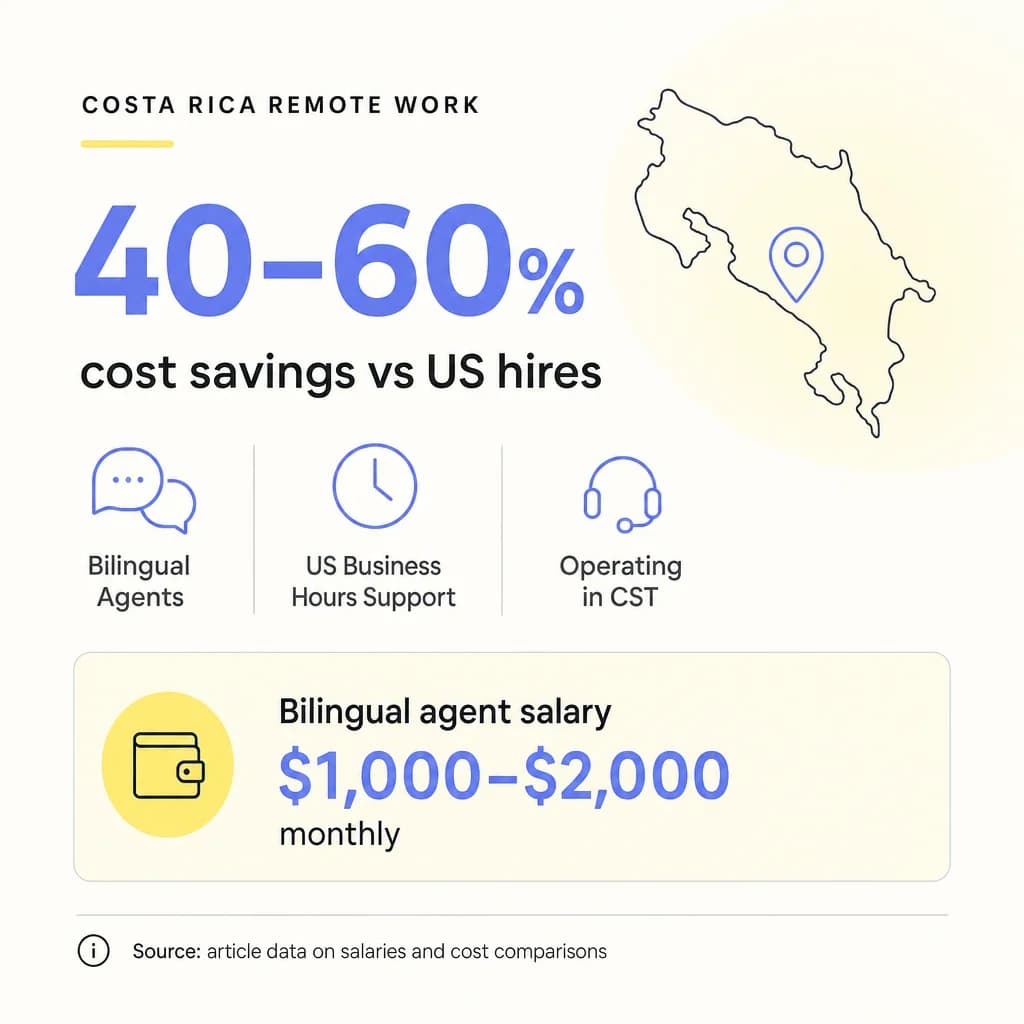
Costa Rica runs on Central Standard Time. That’s one hour behind New York and two hours ahead of Los Angeles.
Your entire US customer base gets same-day support. No night shifts. No waiting. No “I’ll get back to you tomorrow.”
This isn’t a small detail. It’s the entire game.
Why Costa Rica Specifically (And Not Just “Somewhere Cheap”)
Here’s where people get it wrong.
Costa Rican bilingual agents aren’t just “conversational” in English.
We’re talking C2 proficiency. Native-level fluency. These are professionals who’ve worked US call centers for 2+ years minimum. They type 40+ words per minute.
They understand American idioms, cultural references, and tone.
Your customers won’t know they’re talking to someone in San José instead of San Diego.
The Money Part (Because Of Course It Matters)
Let’s be direct about cost.
A bilingual support agent in Costa Rica typically earns $1,000–$1,100 USD per month for entry-level work. Experienced agents with 2+ years in customer support earn about $1,500–$2,000 monthly.
Compare that to the US: $35,000–$45,000 annually for the same role. That’s $2,900–$3,750 per month, not including benefits, payroll taxes, equipment, or office space.
You’re getting 40–60% cost savings. Minimum.
But here’s the part most people miss: the tax structure actually makes this better for everyone.
If you’re a US company hiring a contractor in Costa Rica, they can use the Foreign Earned Income Exclusion (FEIE). This lets them exclude up to $130,000 of foreign-earned income from US taxes.
Costa Rica has a territorial tax system. If the income is earned from foreign sources, digital workers generally owe no Costa Rican income tax.
What does this mean practically?
You can pay competitive rates that feel generous to your contractor, while still keeping your total costs well below US hiring. Everyone wins.
What You’re Actually Getting (Skills That Matter)
Let me be clear about something.
“Bilingual support agent” doesn’t mean someone who took English classes in high school.
The agents you want have real experience. Here’s what to look for:
Minimum 2 years in call center or customer support. They’ve handled angry customers. They know de-escalation. They’ve worked tickets, chats, and phones.
True bilingual capability. Not just Spanish and English. We’re talking code-switching. Understanding when a customer needs formal language versus casual. Catching cultural nuances.
Technical setup already handled. Reliable high-speed internet. Backup power. Proper headset. Home office space. These aren’t luxuries in Costa Rica’s remote work ecosystem, they’re requirements.
Flexibility with US business hours. They work your schedule. Weekends, holidays, overtime when needed. No “that’s not my shift” excuses.
Typing speed and software literacy. 40+ WPM minimum. Comfortable with CRMs, ticketing systems, Slack, Zoom, Google Workspace.
This isn’t entry-level work. These are professionals.
The Part Nobody Talks About (But Should)
Here’s what makes or breaks remote hiring from Latin America.
It’s not the job posting. It’s not even the interview.
It’s how you onboard.
Most companies hire someone in Costa Rica, throw them into the same training as US employees, and wonder why it doesn’t work.
Different country. Different context. Different needs.
Your Costa Rican agent needs crystal-clear documentation. They need recorded training sessions they can review. They need a dedicated point person for questions, especially in the first 30 days.
Time zone overlap helps here. You can do live training during normal business hours. You can have daily check-ins without anyone waking up at 4 AM.
The companies that succeed with Latin American remote workers treat them like core team members, not “offshore resources.” They invest in relationships. They pay on time, every time. They give feedback. They promote from within.
The companies that fail? They treat contractors like disposable vendors.
You get what you give.
What This Actually Solves
Let’s come back to the original problem.
You need customer support that works during US business hours. You need agents who speak perfect English and Spanish. You need it to be affordable enough to scale. You need quality that doesn’t make your customers feel like they’re talking to a script-reader.
Costa Rica checks every box.
Same-day support because of time zone alignment.
Bilingual professionals with real experience.
Cost structure that lets you hire 2–3 agents for the price of one US employee.
Established infrastructure so you’re not pioneering, you’re hiring into a proven system.
This isn’t about finding “cheap labor.”
It’s about finding the right talent in the right place at the right price.
How to Actually Do This
If you’re ready to hire, here’s the path:
Use HireTalent.LAT and then start with one agent. Not five. Not a whole team. One.
Write a clear job description. Specify the hours (in Costa Rican time). List the tools they’ll use. Be explicit about language requirements: C2 English proficiency, native Spanish.
Interview like you would any professional. Ask about their previous support experience. Give them a sample customer scenario. See how they handle it.
Check their internet setup. Ask for a speed test screenshot. Verify they have backup power or a contingency plan.
Start with a 30-day trial period. Paid, obviously. But give both sides an out if it’s not working.
Once you find someone good? Treat them well. Pay on time. Give clear feedback. Include them in team meetings. Recognize good work.
They’ll stay. They’ll refer other quality agents. You’ll build a team.
The Bottom Line
Your time zone problem has a solution.
It’s not complicated. It’s not experimental. It’s not risky.
It’s hiring bilingual support agents in Costa Rica who work during your business hours, speak your customers’ languages, and cost a fraction of US hires.
The infrastructure exists. The talent is there. The companies doing this are already seeing the results.
You just have to start.