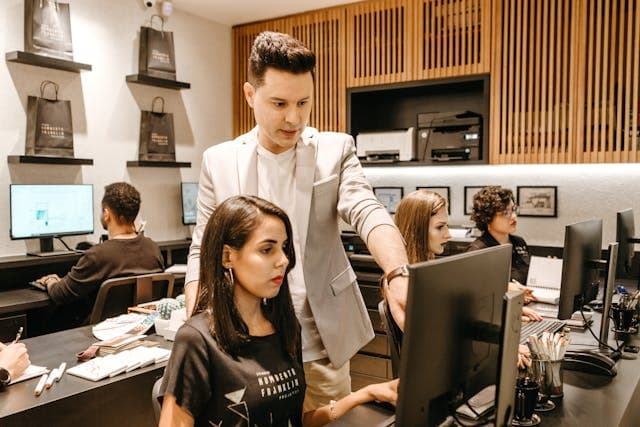
A U.S. manager hires a Colombian developer. Smart, fast, great portfolio.
First week goes well. Second week, the manager gives blunt feedback in a team call. The developer goes quiet. Stops contributing in meetings. The manager thinks they’re disengaged.
They’re not disengaged. They’re mortified.
This is the most common friction point in U.S.-Colombian remote teams — and it has nothing to do with skill.
It has everything to do with expectations nobody talked about upfront.
Are You Looking to Hire in Latin America and Unsure Where to Start?
Sign up for an account and recruit your next employee within minutes!
Get StartedThe Three Places Where U.S. Employers and Colombian Workers Clash
You can trace almost every remote-team breakdown to one of three things.
Feedback style. Time boundaries. Relationship vs. transaction.
That’s it. Most remote-work problems aren’t about performance. They’re about two very different cultural operating systems running in the same workspace.
Here’s what that looks like in practice.
Why Colombian Professionals Give Feedback Differently
In U.S. work culture, directness is a virtue. “No BS” is a compliment. Disagreeing with your manager in a group meeting signals confidence.
In Colombian work culture, that same behavior reads as disrespectful.
Feedback is typically private, relational, and careful. Hierarchy matters. Pointing out someone’s mistake in front of the team isn’t “efficient”, it’s humiliating.
So when a U.S. manager calls someone out publicly, even with good intentions, the Colombian team member doesn’t push back.
They go quiet. They start holding back in meetings. The manager interprets that as lack of ownership.
It’s not. It’s cultural self-protection.
The “Always-On” Expectation Is Burning Out Your LATAM Team
U.S. remote culture has a weird relationship with availability.
Rapid Slack replies. Weekend pings. The unspoken rule that being online = being productive.
Colombian professionals and most of Latin America, draw a much harder line between work time and family time. This isn’t laziness. It’s a different set of values.
Family, rest, and personal life are not things to be squeezed into whatever hours the job doesn’t consume.
When a U.S. employer schedules calls across every shared hour of the day, two things happen. Deep work disappears.
Real delivery gets pushed into evenings. The worker starts feeling like the relationship is extractive, not collaborative.
Colombia Is Relationship-Driven
Colombian professionals want a long-term relationship with the people they work for. They’re not optimizing for the next gig. They want to prove themselves, grow with a team, and build something stable.
That’s actually a retention superpower if you treat it right.
The mistake is treating the hire as purely transactional. Task in, task out. No context, no culture, no connection.
When remote workers feel like line items on a spreadsheet, they leave. When they feel seen and respected, they stay for years.
This doesn’t require a lot. A virtual coffee chat. Acknowledging a local holiday before they have to remind you. Asking how their week went. Small things that signal you’re working with a person, not a resource.
What the Gap Looks Like Side by Side
| Area | Typical U.S. Expectation | Colombian Reality |
|---|---|---|
| Feedback style | Direct, public, “no BS” | Indirect, private, relationship-protecting |
| Time and punctuality | On-time, no lag, “start at 9:00” | Flexible, people-first, some grace on start time |
| Communication cadence | Fast replies, live calls, many check-ins | Respectful, async-friendly, fewer random meetings |
| Work-life boundaries | Often blurred — weekend pings, off-hours | Clear separation between work and family time |
| Pay perception | “Local-cost” reasoning, lower rates | High uplift vs. local wages; still wants fair USD value |
Neither column is wrong. They’re just different defaults. The teams that work well are the ones where both sides understand the other’s starting point.
The Home Environment Nobody Talks About
A lot of Colombian remote workers are working from multi-generational households.
That means shared space, family noise, kids, someone cooking in the background. It’s not a focus problem — it’s a housing reality that looks very different from a U.S. home office with a door.
The workers who navigate this best use time-blocking and Pomodoro-style sprints. Deep work early in the morning before the house wakes up.
Batching emails and messages instead of context-switching every fifteen minutes.
What Colombian Professionals Need Employers to Know About Pay
This one’s uncomfortable, but it needs to be said.
A significant portion of Colombian remote workers — especially in developer and creative roles — feel underpaid relative to U.S.-based peers doing identical work.
Many undercharge because they don’t know what the market rate is.
There’s also a sharper frustration in online communities: some U.S. companies use “remote in Colombia” as a shortcut for “cheap labor” rather than building a real team.
That framing damages trust fast.
The best employers think about it differently. You’re paying below U.S. rates — yes.
But you’re paying well for the local market while getting real-time collaboration, strong English communication, and someone who wants to stay.
Offer a growth path. “After six months, we revisit your rate based on performance” is a sentence that builds more loyalty than almost any perk you could offer.
Holidays Will Surprise You If You’re Not Prepared
Colombia has its own national holidays, religious observances, and regional celebrations that have nothing to do with the U.S. calendar.
Semana Santa (Holy Week) is a major break. So is the Feria de las Flores in Medellín. Carnaval de Barranquilla. Independence Day. The list is longer than most U.S. managers expect.
You will schedule a critical deadline on one of these days. It will happen.
How to Set Up a Remote Team That Actually Works
Here’s the practical version.
Async first, calls second. Default to Loom, Slack, and shared docs. Book live calls only when discussion is genuinely needed. Require a written brief before the call and a recap after.
Set core hours and protect them. Two to three hours of live overlap per day is enough for most roles. Outside those hours, async rules.
Onboard with culture, not just tools. Explain how feedback works on your team. How meetings run. How escalation works. What “done” means. Don’t assume it’s obvious.
Pay fairly and say so out loud. Tell your team member that their rate is competitive, that you’re invested in their growth, and that you’ll revisit compensation as the relationship develops.
Acknowledge the calendar. Know the holidays. Plan around them.
The Real Reason This Matters
Colombian professionals are motivated. They’re educated. Many are bilingual. They’re working in real time, in the same business hours as U.S. East Coast and Central teams.
The talent is there.
What breaks remote teams isn’t skill gaps. It’s two sets of expectations that were never compared out loud. A U.S. manager who reads silence as disengagement.
A Colombian professional who reads public feedback as an attack. Nobody talked about it. Nothing got fixed. A good hire walked out the door.
The teams that get this right don’t have fewer cultural differences. They just decided to understand them instead of ignoring them.