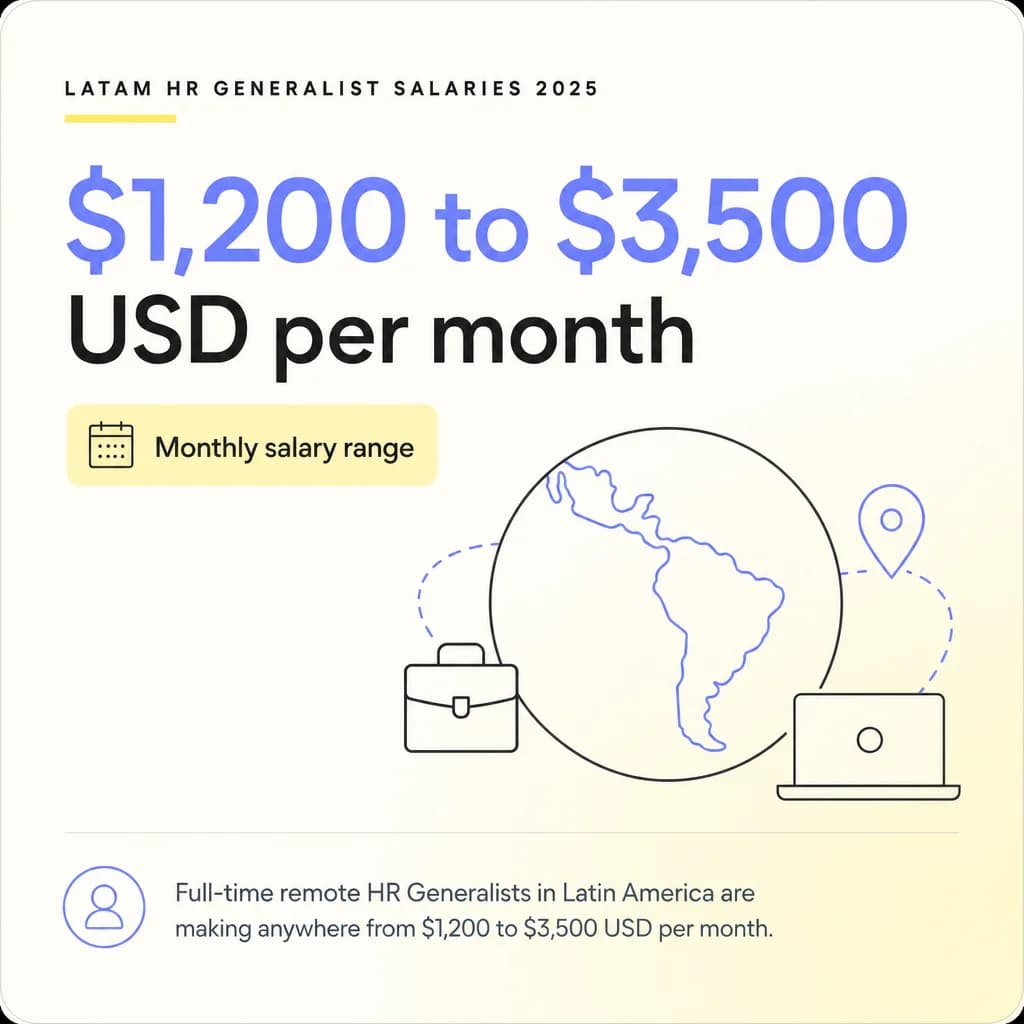
Full-time remote HR Generalists in Latin America are making anywhere from $1,200 to $3,500 USD per month.
That’s a massive range. And that’s the point.
Because “Latin America” isn’t one market. Mexico isn’t Colombia. Brazil isn’t Argentina. And within each country, there’s another massive gap between someone with two years of experience and someone who’s been doing this for a decade.
Let me break this down by country because averages lie.
Mexico: $1,500 – $2,800/month for remote work with international companies. The higher end goes to people in Mexico City or Monterrey with perfect English and experience with US employment law.
Colombia: $1,200 – $2,400/month. Bogotá and Medellín have the most competitive talent. If you speak English fluently and understand HRIS systems, you’re at the top of that range.
Argentina: $1,800 – $3,200/month. But here’s the thing with Argentina — inflation is wild. These numbers shift fast. Many Argentine HR professionals prefer getting paid in USD rather than pesos.
Brazil: $1,400 – $2,800/month. English proficiency makes or breaks your rate here. Portuguese-only HR Generalists stay at the lower end unless they’re working for Brazilian companies expanding regionally.
Chile: $1,600 – $3,000/month. Often overlooked but Chilean HR talent is solid. Stable economy, good education system, strong work ethic.
These are full-time contractor rates. Not employee salaries with benefits. Not freelance hourly gigs. This is what people actually get paid to work 40 hours a week remotely for companies outside their country.
Hourly Rates Are a Different Game
Some HR Generalists work hourly instead of monthly. This makes sense if you’re building up multiple clients or testing the waters with remote work.
Hourly rates I’m seeing: $12 to $30 per hour.

The $12/hour person? Usually newer to remote work. Maybe great at HR but still figuring out how to communicate with international teams. Probably undervaluing themselves.
The $30/hour person? Specialized. Maybe they handle HR compliance for companies expanding into Latin America, or they’re experts in a specific HRIS platform. They’ve figured out their value and they’re not budging.
Most solid mid-level HR Generalists land between $15-22/hour. That’s someone who can handle recruitment, onboarding, basic payroll coordination, employee relations, and policy documentation without hand-holding.
What Actually Affects Your Rate
Experience matters. But it’s not everything.
I’ve seen HR professionals with eight years of experience stuck at $1,400/month because they only worked for local companies. Then I’ve seen someone with three years jump to $2,500 because they worked for one US startup and learned how international teams operate.
English proficiency is huge. Not “I studied English in school” proficiency. Real conversational fluency — the kind where you can handle a difficult employee situation over Zoom without stumbling.
Technical skills separate the pack. If you know BambooHR, Gusto, Rippling, or Deel inside and out, you’re worth more. If you can set up workflows and integrations, even better.
Understanding international employment law (especially US basics) puts you ahead. You don’t need to be a lawyer. But knowing the difference between a contractor and an employee, understanding at-will employment, and grasping basic compliance issues makes you more valuable.
Time zone flexibility affects rates too. If you can work US hours (even just overlap for 4–5 hours), you’re more attractive to American companies. And American companies generally pay better than European ones for LATAM talent.
The Freelance Platform Reality
Platforms like Freelancer, Upwork, and Fiverr show a darker picture.
You’ll see bids as low as $2 to $8 per hour for HR-adjacent work: writing job descriptions, creating employee handbooks, drafting policies.
These aren’t real market rates. These are desperation rates.
Someone bidding $5 per hour to write an employee handbook either doesn’t understand their value or they’re in a tough spot financially. Maybe both.
Don’t compete there. If you’re a Latin American HR professional worth hiring, platforms like HireTalent.LAT connect you directly with US, UK, and Australian employers who are looking for experienced remote professionals at fair rates, not the cheapest option available.
And if you’re hiring, understand that $5 per hour gets you $5 per hour quality. You’ll spend more time fixing problems than you saved on the rate.
The better move is finding pre-vetted candidates through a platform built for this market, where the rates reflect actual skill levels and both sides know what they are getting into.
The Experience Tiers (What You Should Actually Charge)
Junior (0–2 years): $1,000–1,600/month or $10–15/hour
You’re learning. You can handle basic tasks with guidance. You’re worth hiring but you need support.
Mid-level (3–5 years): $1,600–2,500/month or $15–22/hour
You can run most HR functions independently. You’ve handled difficult situations. You know your way around HR software. This is where most remote HR Generalists land.
Senior (6+ years): $2,500–3,500/month or $22–35/hour
You can build HR systems from scratch. You’ve managed teams or entire HR departments. You understand strategy, not just tasks. Companies hire you to solve problems, not just execute.
Specialized: $3,000–5,000+/month or $30–50/hour
You have a specific expertise that’s hard to find. Maybe LATAM expansion compliance. Maybe HR tech implementation. Maybe building remote-first cultures. You’re not just an HR Generalist anymore.
What This Means If You’re Hiring
You can find incredible HR talent in Latin America at rates that make sense for your business. But don’t be cheap about it.
Paying $1,200/month when you should pay $2,000 means you’ll get someone who leaves the moment they find something better. And they will find something better.
The best LATAM HR professionals have options. Lots of them.
Offer fair rates.
Respect their expertise.
Treat them like the professionals they are, not like “cheap labor.”
Start people on trials if you want. Three months is reasonable. But pay them fairly during that trial.
Understand that someone making $2,500/month from you is saving your company $3,000–4,000 per month compared to a local hire. You’re still winning.
The 2026 Shift
Rates are going up. Not dramatically, but steadily.
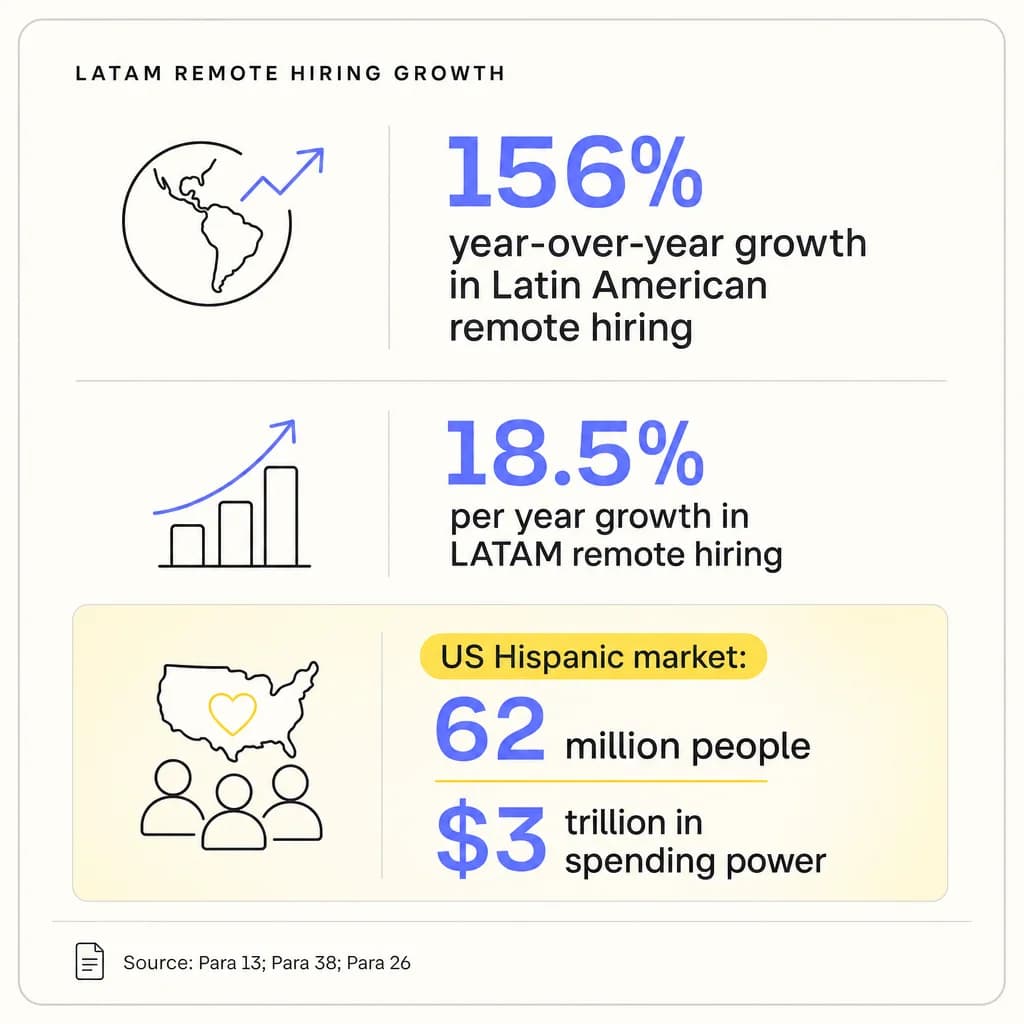
More companies are hiring remotely from Latin America. More LATAM professionals are getting experience with international companies. The talent pool is getting more sophisticated.
The days of finding senior HR talent for $1,000/month are over. They were never really here.
If you’re an HR professional in Latin America, this is good news. Your skills are more valuable than ever.
If you’re a company hiring, this is still good news.
You’re still getting incredible value. You just need to be realistic about what that value costs.