Companies hiring remote Project Managers are nervous.
They’re spending real money on someone they’ll never meet in person, someone who might be eight time zones away (even though you’re probably just one or two hours off from US East Coast time).
They need proof you can deliver. Fast proof.
A hiring manager in Austin or London will spend maybe 90 seconds on your materials before deciding whether to keep reading. Your portfolio either grabs them in that moment or it doesn’t.

What Makes a Portfolio Actually Work
Forget what you’ve heard about fancy design or expensive websites.
Your portfolio needs to do one thing: show you can manage complex projects remotely and deliver results that matter to their bottom line.
That’s it.
But how you show that makes all the difference.
Start With a Summary
Most PM portfolios start with fluff: “Dedicated professional with a passion for excellence.” Delete all that.
Here’s what works: three sentences that tell them exactly who you are, what you’ve done, and why geography doesn’t matter.
Something like:
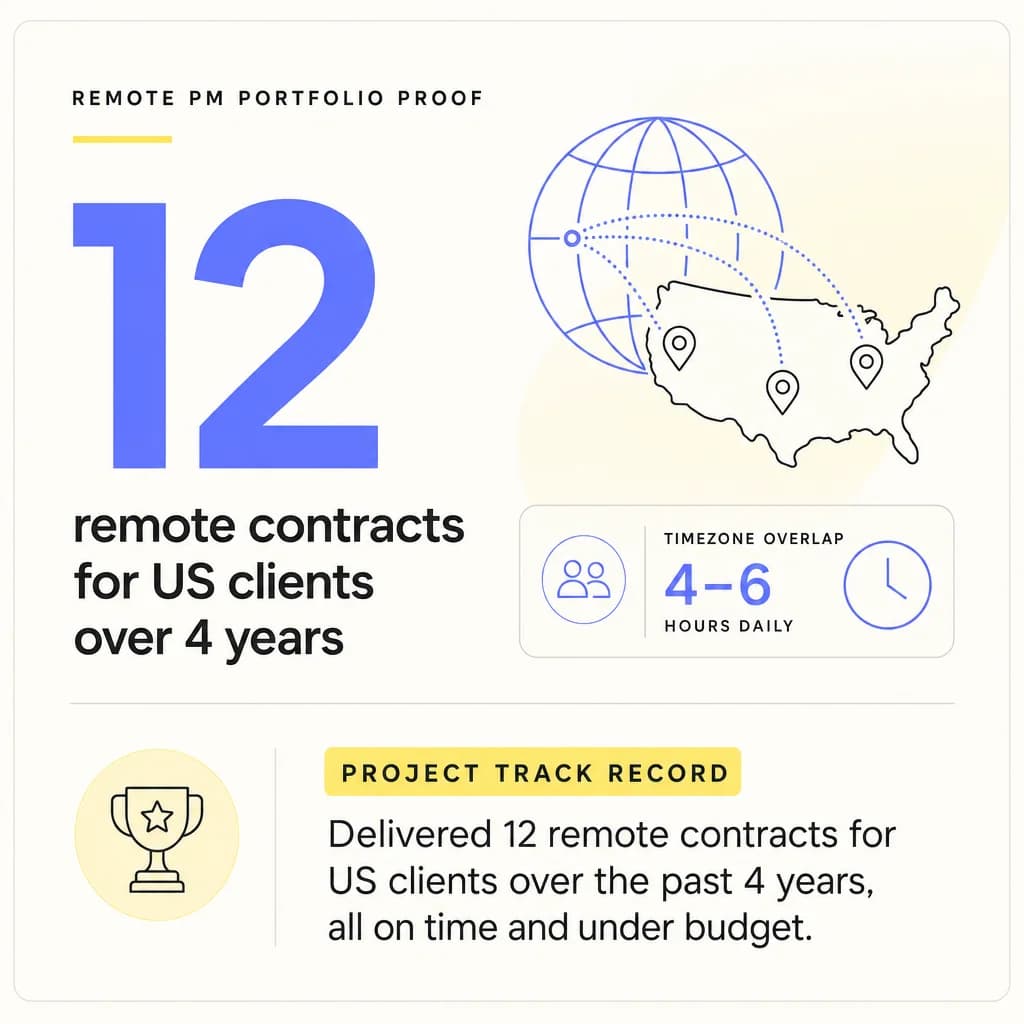
“Project manager specializing in cybersecurity implementations for mid-size tech companies. Delivered 12 remote contracts for US clients over the past 4 years, all on time and under budget. Based in São Paulo with full overlap during EST business hours.”
See the difference? They immediately know your specialty, your track record, and that timezone won’t be an issue.
Add your certifications right here: PMP, CSM, PRINCE2, whatever you’ve got. But only if they’re real. Companies can smell fake credentials from a mile away.
If you’ve saved clients money or time, put that number right up front. “Reduced project overruns by 30% across 8 implementations” hits harder than any flowery language ever will.
Case Studies Are Where You Win or Lose
This is the heart of everything.
You need three to five detailed case studies. Not project descriptions. Not task lists. Actual stories of problems you solved.
Here’s the structure that works:
The Situation
What was broken? What was at risk? Be specific but keep client names anonymous if needed.
“A fintech company was three months into a compliance audit with no clear timeline, seven stakeholders who wouldn’t align, and a vendor who kept missing deadlines.”
That’s a problem anyone can visualize.
What You Did
This is where most people mess up. They list activities instead of decisions.
Don’t tell me you managed stakeholders. Tell me you set up weekly alignment calls with all seven stakeholders, created a shared dashboard that showed dependencies in real-time, and personally called the vendor’s CEO to renegotiate deliverable dates.
Specifics. Always specifics.
The Results
Numbers. Always numbers.
“Delivered the audit two weeks early, came in 15% under budget, and the client expanded the contract for three additional projects.”
That’s what hiring managers screenshot and send to their boss.
Every case study needs visuals: a Gantt chart showing the timeline, a risk matrix you actually used, screenshots of your project dashboard, before-and-after comparisons.
You can build these in free tools like Canva or Lucidchart. They don’t need to be pretty. They need to be real.
One more thing: include something about remote collaboration in each case study—how you handled the distance and kept people aligned across time zones. This is what they’re actually worried about.
Show Your Tools, Not Just Your Titles
Companies want to know you can jump in without a three-month learning curve.
Create a simple section that shows your actual proficiency with the tools they use every day: Jira, Asana, Microsoft Project, Wrike.
But don’t just list them. Show them. Embed a screenshot of a dashboard you built. Link to a template you created. Anything that proves you’ve actually used these tools to manage real work.
Add a section on your domain knowledge too. If you’re going after cybersecurity PM roles, show you understand risk frameworks and compliance requirements.
If it’s software development, show you know Agile ceremonies inside and out.
The goal is to eliminate every question mark in their head.
Let Other People Brag About You
Testimonials feel awkward to ask for. I get it. Do it anyway.
Reach out to three to five people you’ve worked with on remote projects: former clients, team members from other countries, stakeholders who saw you in action.
Ask them for two sentences about working with you remotely. Most people will say yes if you make it easy for them.
The best testimonials mention specific outcomes. “Maria saved us $40,000 by catching a vendor issue two weeks before it would have derailed our launch” is worth ten generic “great to work with” comments.
If you can get video testimonials, even better. A 30-second clip of someone in Boston talking about working with you from Buenos Aires is pure gold.
The Technical Stuff That Actually Matters
You can build your portfolio a bunch of ways. Notion works great and it’s free. So does Google Sites. WordPress if you want something more traditional.
The platform doesn’t matter. What matters is that it loads fast on mobile (most hiring managers will look at it on their phone first) and doesn’t require them to download anything.
Keep it simple: five to ten pages max, clean navigation, no auto-playing videos or pop-ups.
Make sure everything is in English. Even if you’re also targeting LATAM companies, US and UK clients expect English portfolios. You can always create a Spanish version separately.
The Mistakes That Kill Your Chances
I see the same errors over and over:
Too much text. If I’m scrolling for more than three seconds without seeing a chart, a number, or an image, you’ve lost me. Break up everything. Use bullet points. Add visuals constantly.
No metrics. “Managed a successful project” means nothing. “Delivered a 6-month implementation in 4.5 months, saving the client $30,000” means everything.
Generic examples. Every case study should feel specific to a real situation. If I could copy-paste your case study into someone else’s portfolio without changing anything, it’s too generic.
Ignoring the remote angle. Companies hiring remotely are specifically worried about remote challenges. If you don’t address how you handle communication, time zones, and async work, they’ll assume you can’t.
Making them work too hard. Every click should be obvious. Every section should be skimmable. If they have to hunt for information, they won’t.
How to Use Your Portfolio To Your Advantage
Building the portfolio is step one. Getting it in front of the right people is step two.
Put the link in your LinkedIn headline.
Add it to your email signature.
Include it in every job application, even if they don’t ask for it.
When you’re applying for remote contract roles, don’t just attach your resume. Write a short note like:
“I’ve managed similar cybersecurity implementations for US clients remotely. Here’s a case study that shows exactly how I handled the risk management challenges you mentioned in the job description: [link]”
That’s how you stand out.
Share individual case studies on LinkedIn. Write a post about a challenge you solved and link to the full story in your portfolio. Tag relevant people. Join conversations in PM groups.
The portfolio isn’t a static thing you build once. It’s a living document: every successful project becomes a new case study, every new certification gets added, every great testimonial goes in.
Update it every quarter at minimum.