You can’t tell if someone’s good at sales development from a resume.
You just can’t.
They’ll tell you they “generated 500 leads monthly” or “achieved 120% of quota.” Sounds great. Means nothing until you see them work.
This is especially true when you’re hiring from Latin America.
Not because the talent isn’t there. It absolutely is. Some of the best SDRs I’ve worked with are from Colombia, Argentina, and Mexico.
But because the interview process lies to both of you.
They’re nervous. Trying to impress you. You’re trying to assess them in 30 minutes. It’s impossible.
The Only Way to Actually Know
Not a test. Not some fake scenario. Real work. The actual job they’d be doing.
And you pay them for it.
If the role extends from prospecting into closing, the same paid-trial principle can help you vet and hire elite closers using role-play, conversion KPIs, and real follow-through.
This changes everything.
What You’re Actually Testing For
Forget the corporate competency matrix nonsense.
You need to know four things:
Can they find the right people? Lead research is 50% of the job. If they can’t identify decision-makers or understand your ideal customer profile, nothing else matters.
Can they write emails that don’t suck? Most cold emails are terrible. You need someone who can write like a human, not a sales robot.
Do they follow through? This is the big one. Lots of people start strong. Few finish strong.
Can they use the tools? Salesforce, LinkedIn Sales Navigator, whatever you use. If they’re clicking around confused, that’s a problem.
Here’s How to Set It Up
Keep it simple. Seriously.
Most companies overcomplicate this. They create some elaborate 40-page brief with seventeen requirements.
That’s not a trial. That’s a hazing ritual.
Here’s what works:
Give them a real slice of the job.
“Find 30 companies that match our ideal customer profile. Find the VP of Sales or Head of Growth at each. Send them a personalized cold email. Log everything in this spreadsheet.”
That’s it.
I pay $100–150 for an 8–10 hour trial. Sometimes more.

This isn’t charity. This is respect.
When you pay people, they take it seriously. When you don’t, you get their leftover energy.
Plus, in Latin America, $100–150 is real money. It shows you’re legitimate.
Set a deadline.
Two days usually works. Maybe three if it’s a more complex task.
You’re testing if they can manage their time. If someone takes a week to do 8 hours of work, that tells you something.
The Actual Task That Works
I’ve tested probably fifteen different trial formats.
This one consistently separates the great from the mediocre:
Day 1: Research and Setup (3–4 hours)
Give them access to LinkedIn Sales Navigator or Apollo.io. Or just LinkedIn if you’re keeping it simple.
Provide a clear ideal customer profile. Be specific. Example: “B2B SaaS companies, 20–100 employees, using HubSpot, based in the US, raised Series A in the last 18 months.”
They need to find 30–50 companies and the right contact at each.
Watch how they document this. The good ones create clean spreadsheets. The mediocre ones give you a mess.
Day 2: Outreach (4–5 hours)
They write and send personalized emails to everyone they found.
Not templates. Not “Hi [FIRST_NAME]” garbage.
Real personalization. Something that shows they looked at the company.
They send these from a temporary email you set up. Or their own if you’re comfortable with that.
Track open rates and responses.
Day 3: Follow-up and Debrief (1–2 hours)
They log all responses. Qualify the interested ones using whatever framework you use (BANT, MEDDIC, whatever).
Then you jump on a call. Ask them to walk you through their process.
Questions to ask on the call:
“Why did you choose these companies?”
“Show me your best email.”
“What would you do differently?”
The conversation tells you more than the deliverables.
What Good Actually Looks Like
Response rates above 15%. That’s solid for cold outreach.
But honestly, the number matters less than the quality.
I’ve hired people who got 10% response rates because the responses were from perfect-fit prospects saying “tell me more.”
I’ve passed on people who got 25% response rates from completely wrong companies.
Look for thinking.
Did they just blast generic emails? Or did they actually research each company?
One candidate I hired spent extra time finding a company’s recent podcast interview and referenced it. That’s the stuff you can’t teach.
Look for clean work.
Is their spreadsheet organized? Are there typos in their emails? Do they use proper grammar?
Details matter in sales. Sloppy trial work means sloppy actual work.
Look for questions.
The best candidates ask clarifying questions. “Should I prioritize companies in certain industries?” or “What’s more important, volume or personalization?”
People who don’t ask questions either don’t care or are too scared to admit they don’t understand.
Red Flags That Mean Move On
They miss the deadline without communication. If they can’t manage a simple trial timeline, they can’t manage a sales pipeline.
Copy-paste emails. If every email is identical except the company name, they don’t get it.
They disappear. Sounds obvious, but I’ve had people ghost mid-trial. Just vanish.
They argue about feedback. During the debrief, if you point out something they could improve and they get defensive, that’s your future every week.
Inflated metrics. “I sent 100 emails!” But you can see they only sent 30. Lying during a trial means lying during employment.
The Money Part
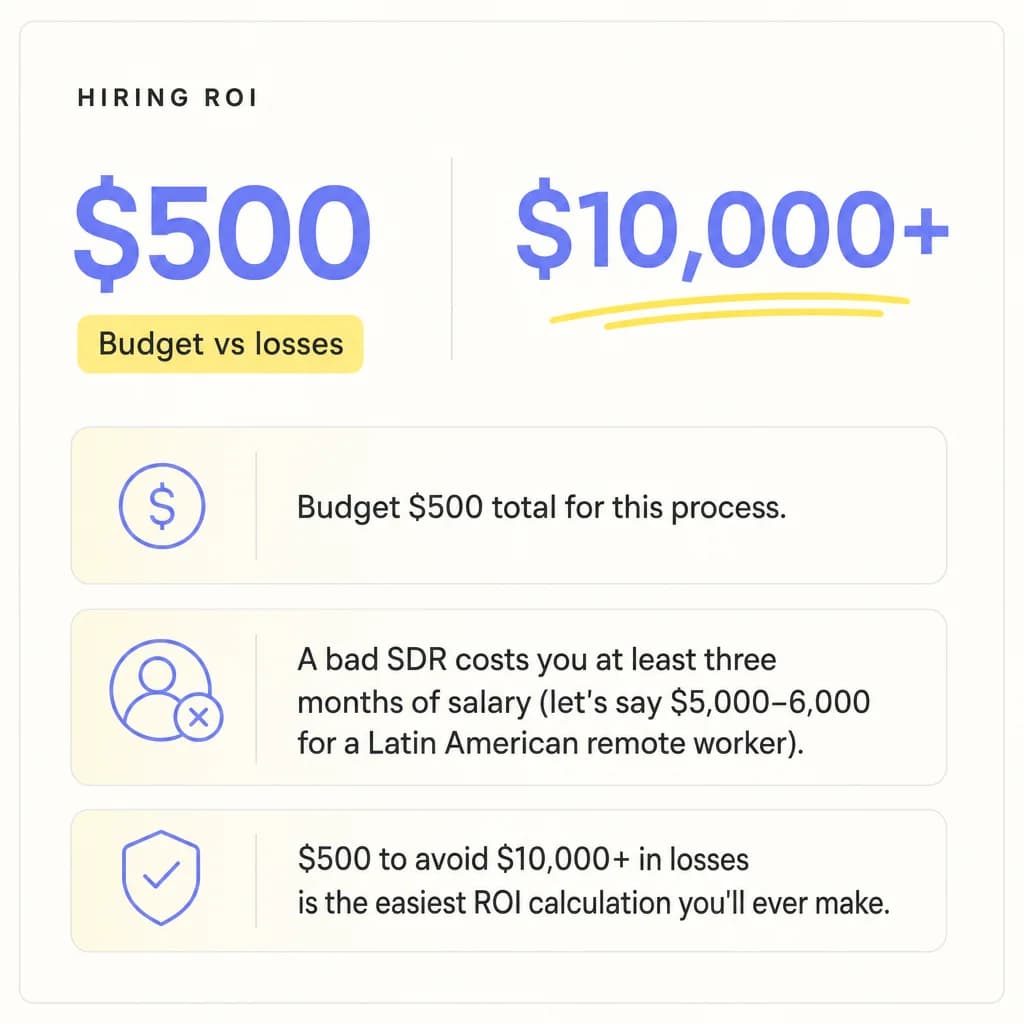
Budget $500 total for this process.
That’s five candidates at $100 each.
Seems like a lot? Compare it to the cost of a bad hire.
A bad SDR costs you at least three months of salary (let’s say $5,000–6,000 for a Latin American remote worker). Plus your time training them. Plus the opportunity cost of deals not closed.
$500 to avoid $10,000+ in losses is the easiest ROI calculation you’ll ever make.
Start Simple
You don’t need a perfect system.
You need to see someone do the actual work before you hire them.
That’s it.
Pick your top three candidates. Pay them to do a real task. See who delivers.
Then hire that person.
Everything else is just noise.
Ready to find your next SDR? Head to HireTalent.lat to connect with pre-vetted sales development professionals across Latin America.